
Mowing FAQs
Mowing FAQs
Have questions about lawn mowing? Here are quick answers to the most common things homeowners ask.
How often should I mow my lawn?
Most lawns need at least weekly mowing during the active growing season and less frequent mowing during cooler or dormant months. The right schedule depends on grass type, rainfall, temperature, irrigation, and how fast your lawn is growing. The short you maintain your turf, the more frequent you will need to mow.
Table 1. Mowing frequency as determined by the one-third rule.
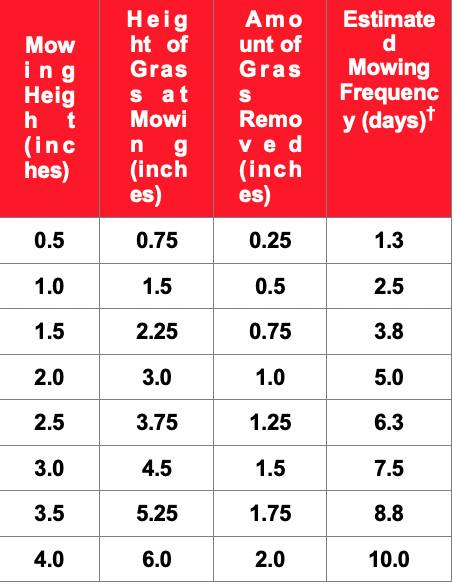
†Estimate based upon a daily growth rate of 0.2 inches.
What height should my grass be cut?
We mow at a healthy height for your grass type and the season. As a general rule, we would recommend avoid removing more than one-third of the grass blade at one time because cutting too short can stress the lawn and lead to thinning or brown spots.
Suggested mowing heights vary between warm season turf types. Frequency of mowing also plays part in how short the turf can be maintained. Shorter turf heights will require more frequent mowing.
On a seven-day mowing interval we recommend;
Bermuda - 1.5 to 3 inches
Zoysia – 2 to 3 inches
St. Augustine – 3 to 4 inches
Table 1. Mowing frequency as determined by the one-third rule.
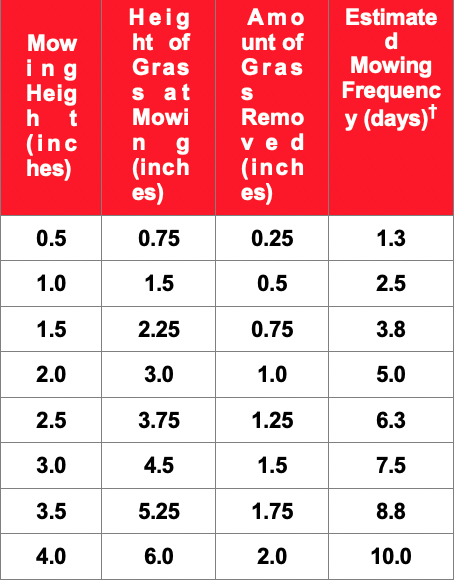
†Estimate based upon a daily growth rate of 0.2 inches.
Should I bag grass clippings?
In most cases, we recommend to mulch clippings back into the lawn because they break down quickly and return nutrients to the soil. Bagging may be needed or recommended when the lawn is overgrown.
A study conducted in Fort Worth, Texas, found that 147 homeowners who quit bagging their clippings mowed 5.4 times per month versus 4.1 times when they bagged clippings but saved an average of 35 minutes per mowing by not bagging clippings. After six months of returning clippings, these homeowners saved an average of seven hours of yard work, even though they mowed more often. There are special mulching mowers on the market, but they are not necessary for recycling clippings.
When grass clippings are allowed to decay naturally on the lawn, they release valuable nutrients which improve the soil. If clippings are returned, fertilizer applications can be reduced by 30 percent. Returning the clippings to your lawn will supply approximately 1 pound of N/1,000 ft2/year.
Clippings contribute to the formation of organic matter, which makes the soil softer and plants more drought tolerant. Organic matter also encourages the presence of earthworms which are very effective in preventing thatch accumulation.
Can you mow an overgrown lawn?
Yes. Overgrown lawns may require extra time, a higher first cut, or multiple mowings within a week to bring the grass down safely without scalping. When you mow regularly and at the proper height, your lawn is improved by recycling grass clippings. If you allow the grass to grow too long between mowings, excessive clippings left on the surface can smother and damage your lawn. Reduce this problem by gradually lowering your lawn to its proper height over a period of two or three mowings, rather than scalping it back to its normal height in one mowing.
Can I choose weekly or biweekly mowing?
Yes. Weekly mowing is usually best during fast-growth months, while biweekly service may work during slower growth periods. We can recommend a schedule that keeps your lawn looking clean without cutting too much at once.
Why are sharp mowing blades important?
Sharply-cut leaf blades increase turf health by improving recovery, decreasing water loss and increasing photosynthesis. Lawns mown with a dull mower blade have poor aesthetics, heal more slowly and have greater water loss.
Leaf blade A demonstrates what a leaf blade should look like after mowing. Leaf blade B demonstrates a leaf blade injured by a dull mower blade. Leaf blade C was cut by the mower, but its condition indicates that the mower blade was not sharp enough. The white tissue sticking out of the leaf blades (C and D) is the vascular tissue of the plant. Leaf blade D was mown for quite some time with a dull mower blade.
Should I mow my bermudagrass or zoysiagrass low on my first mowing of the year?
Yes, for bermudagrass and zoysiagrass. Before bermudagrass and zoysiagrass begin to grow in the spring, mow the turf slightly shorter than normal to remove dead leaf blades and other debris. This practice will reduce shading of the emerging plants and also serves to warm soil temperatures more quickly in the spring. The result is a lawn that greens-up more quickly in the spring. The risk in this practice is that you could scalp some of the emerging grass if this practice is delayed until after the lawn has begun to green-up. Carefully inspect the turf before removing dead leaf tissue and debris to ensure there are no green shoots emerging. Zoysiagrass lawns often do not go fully dormant like bermudagrass during winter. Therefore, this practice is likely to be more damaging on a zoysia-grass lawn than a bermudagrass lawn.
No, for St. Augustinegrass. Low mowing in early spring is damaging to St. Augustinegrass lawns since they spread by above-ground stems (stolons) and are more prone to injury from this practice.